
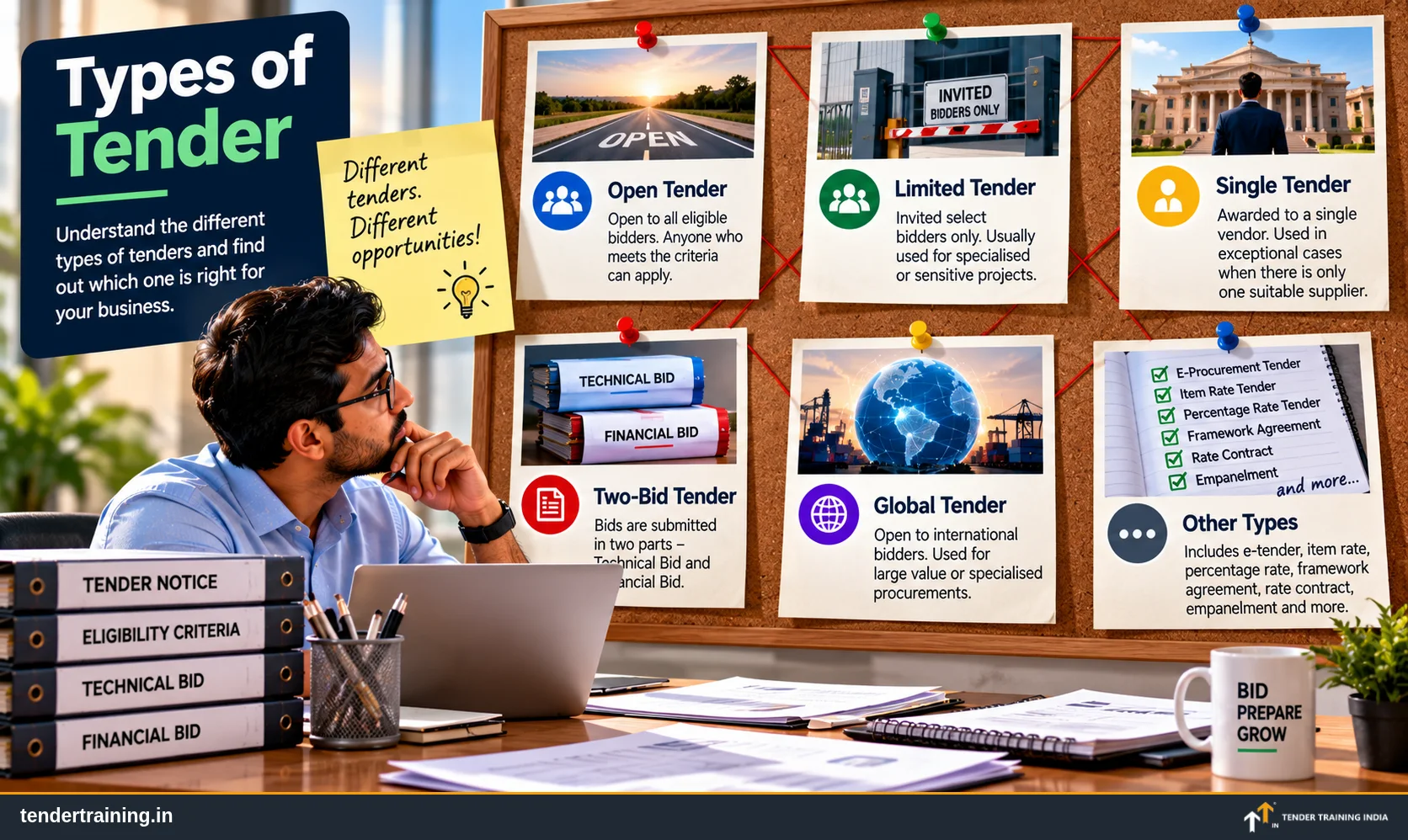
- Tenders are grouped by who can bid (open, limited, single, global) and by how bids are submitted (single cover, two bid, two stage).
- Open tenders are the most common and the easiest door for a new bidder.
- Limited tenders need you to be registered or empanelled with the department first.
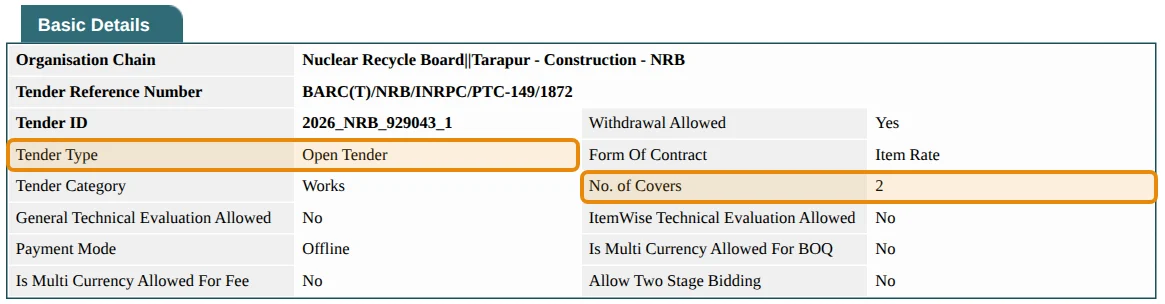
- The tender page shows the type as "Tender Type" — read it before anything else.
On every eProcurement tender page, one of the first lines is "Tender Type". Most of the time it says "Open Tender" — but not always. The type tells you whether you are even allowed to bid, and what kind of preparation the tender needs.
By who can bid
| TYPE | WHAT IT MEANS | FOR YOU |
|---|---|---|
| Open tender | Published publicly; anyone who meets the eligibility can bid. | The main door for new bidders. Watch CPPP, state portals and GeM. |
| Limited tender | Sent only to a list of registered / empanelled / approved suppliers. Usually for smaller values or specialised items. | Get registered or empanelled with the departments you want to supply to. |
| Single tender | Only one supplier is asked — for example the only maker of a proprietary item, or in an emergency, with recorded reasons. | Happens when you are the OEM of a unique product, or the original supplier of spare parts. |
| Global tender (GTE) | Foreign companies can also bid. Central rules restrict global tenders below a high value limit, to give Indian suppliers a chance. | Mostly large, specialised purchases. Watch for Make in India conditions. |
By how bids are submitted and judged
- Single cover: documents and price in one cover. Used for simple or low-value purchases.
- Two bid (two cover): technical bid and financial bid separately; price opened only for qualified bidders. The most common — see Technical bid vs financial bid.
- Two stage: for complex items. First the buyer discusses technical proposals and finalises specifications; then bidders submit revised technical and price bids.
- Item-wise / lot-wise: evaluated item by item, so different items can go to different bidders — see Financial evaluation: total-wise, item-wise and multiple L1.
Other terms you will see
- EOI (Expression of Interest): the department first asks interested firms to show their capability. Shortlisted firms are invited to the actual tender. Common for consultancy and large projects.
- Rate contract: a contract that fixes rates for an item for a period (say one year). Departments then place orders as needed at that rate.
- Empanelment: a list of approved suppliers or service providers, valid for a period. Being empanelled often makes you eligible for limited tenders.
- Works, goods and services tenders: works (construction, repair), goods (products), services (manpower, AMC, transport, consultancy) — each has its own standard conditions.
Meena makes LED lights in Nashik. She starts with open GeM bids and listings for LED tubes. After a year of orders, she applies for empanelment with two state electricity companies — which brings her into their limited tenders, where there are fewer competitors. Her first two-bid open tender comes after she has three supply orders to show as experience.
Ask us on WhatsApp — we reply personally, usually the same day.
Ask on WhatsApp
Hiral Dron
Founder, Tender Training India · GeM Gold Certified · 15+ years in tendering, GeM and procurement advisory. Training MSMEs in government tendering since 2016.