
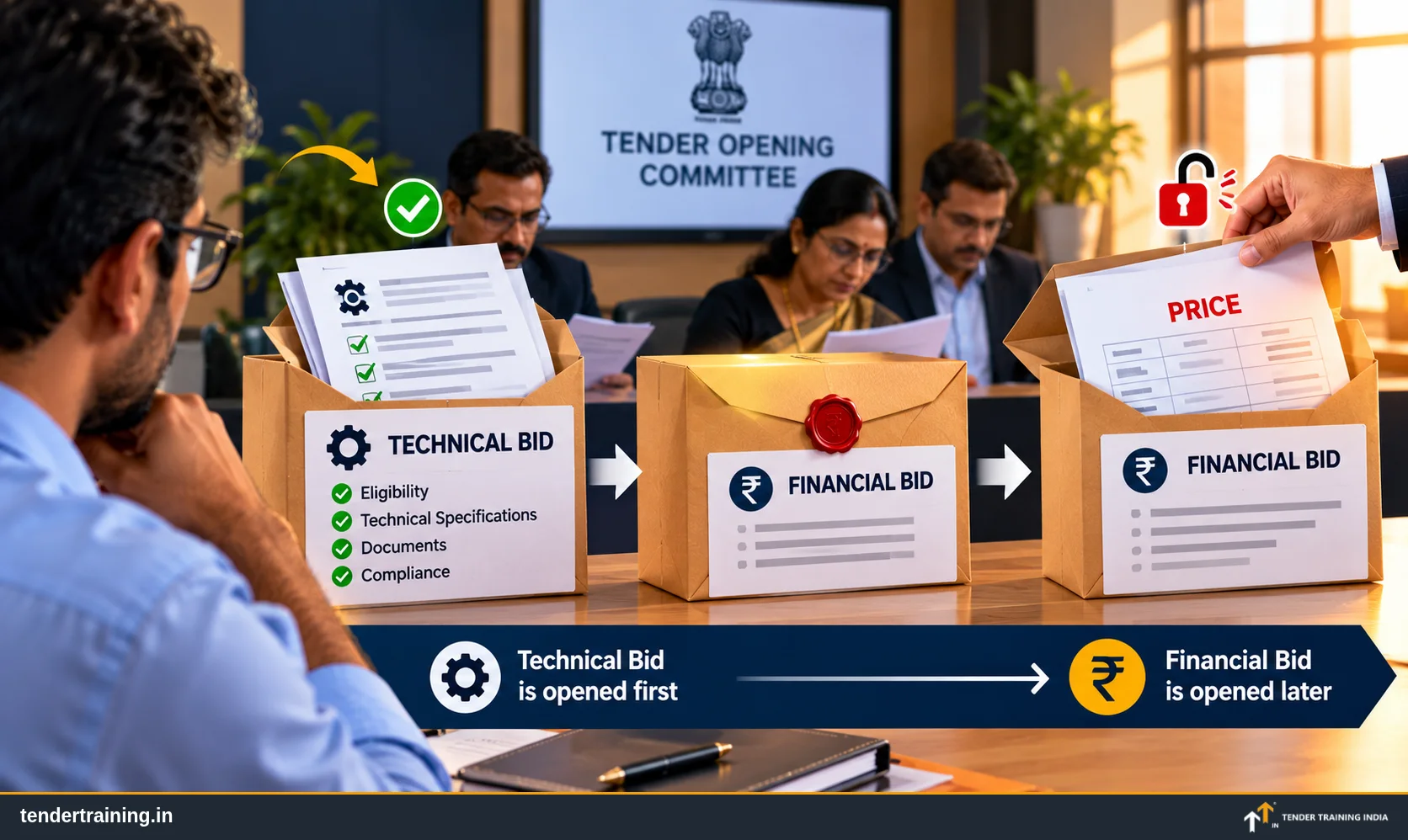
- Most tenders use a two-cover system: a technical bid and a financial bid.
- The technical bid proves you are eligible and your offer meets the specifications. No prices.
- The financial bid is your price — usually the BOQ.
- Technical bids are opened first. Only qualified bidders' prices are opened.
In the old days, bidders submitted two sealed envelopes: one with documents, one with the price. The department opened the document envelopes first, decided who qualified, and only then opened the price envelopes of those who passed. Online tenders work exactly the same way — the envelopes are now called covers.
Why two separate bids?
To keep the process fair. If the committee saw prices first, it might be tempted to qualify a cheaper bidder who doesn't really meet the conditions. By judging capability first and price later, every qualified bidder is compared only on price.
What goes in each cover
The tender page shows the number of covers and exactly what goes into each. Here is a real example:
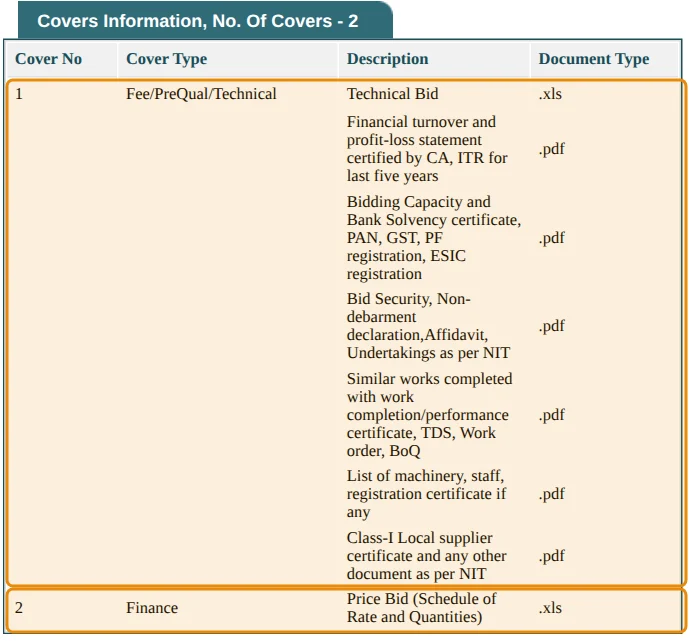
| TECHNICAL BID (COVER 1) | FINANCIAL BID (COVER 2) | |
|---|---|---|
| Purpose | Prove you are eligible and your offer meets the specs. | Give your price. |
| Typical contents | Fee and EMD proof (or exemption certificate), eligibility documents, experience, registrations, declarations, technical details, brochures, compliance sheet. | Filled BOQ / price schedule — nothing else unless asked. |
| Opened | First, on the bid opening date. | Later, only for bidders who qualified technically. |
| Prices allowed? | No — never. | Yes. |
How the evaluation happens, step by step
- Technical opening: the committee opens Cover 1 of all bidders — say 9 bids.
- Evaluation: it checks each document against the tender. It may ask a bidder to clarify a document, if the tender allows.
- Result: 6 bidders are technically qualified, 3 are rejected (one missing ESIC, one short on experience, one with an unsigned declaration).
- Financial opening: only the 6 qualified bidders' Cover 2 is opened. The 3 rejected bidders' prices are never seen.
- Comparison: the lowest qualified price is L1 — see Financial evaluation: total-wise, item-wise and multiple L1.
On eProcurement portals, you can follow these stages in the tender's status: technical evaluation, then financial evaluation, then the result (AOC — award of contract).
Other cover systems you may see
- Single cover: everything in one cover — used for smaller or simpler purchases.
- Three or more covers: for example, a separate cover for fee/EMD, or for pre-qualification, before the technical cover.
- Two-stage bidding: for complex purchases, the buyer first discusses technical offers, finalises the specifications, and then invites revised technical and price bids.
The tender page always shows "No. of Covers" — check it before you start preparing.
What about GeM?
On GeM, you upload your documents and enter your price in the same bid, but the logic is the same: the buyer first does the technical evaluation, and only the prices of technically qualified sellers are compared. Some bids end with a reverse auction among the qualified sellers.
Ask us on WhatsApp — we reply personally, usually the same day.
Ask on WhatsApp
Hiral Dron
Founder, Tender Training India · GeM Gold Certified · 15+ years in tendering, GeM and procurement advisory. Training MSMEs in government tendering since 2016.