
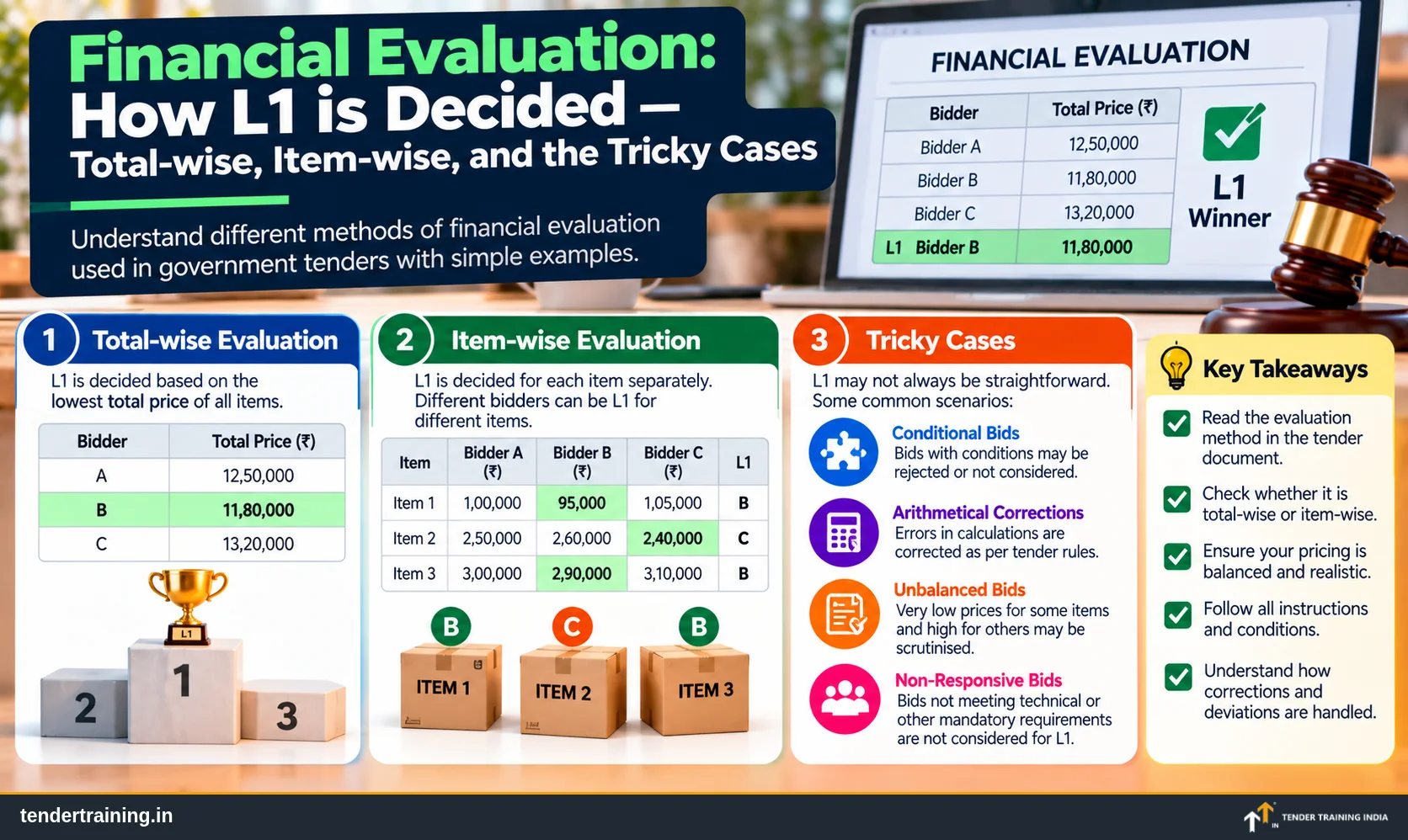
- L1 = the lowest-priced bidder among those who qualified technically. L2 is the second lowest, and so on.
- The tender decides what is compared: the grand total (total-wise), each item (item-wise), or each group (lot-wise).
- If the L1 price is too high, the department may negotiate with L1 or re-tender. If it is too low, it may ask for justification or extra security.
- If two bidders tie as L1, the tender's tie-break rule applies.
Once technical evaluation is over, the financial bids of qualified bidders are opened and arranged from lowest to highest: L1, L2, L3. In most government tenders, L1 wins. But how L1 is worked out depends on one important line in the tender — the basis of evaluation.
Total-wise, item-wise or lot-wise?
Total-wise (overall L1)
All items are added up and the bidder with the lowest grand total wins the whole order — even if they are not the cheapest on every item.
Item-wise
Each item is compared separately. Different items can go to different bidders.
Lot-wise / group-wise
Items are grouped into lots. The lowest total for each lot wins that lot.
| ITEM (QTY) | BIDDER A | BIDDER B | BIDDER C |
|---|---|---|---|
| Desks (100) | ₹3,00,000 | ₹2,80,000 | ₹3,10,000 |
| Chairs (200) | ₹2,40,000 | ₹2,90,000 | ₹2,60,000 |
| Almirahs (20) | ₹1,80,000 | ₹1,70,000 | ₹1,60,000 |
| Total | ₹7,20,000 | ₹7,40,000 | ₹7,30,000 |
- Total-wise: A is L1 (₹7.2 lakh) and gets everything.
- Item-wise: B gets desks, A gets chairs, C gets almirahs.
Same bids — completely different winners. That is why you must check the basis of evaluation before pricing. In a total-wise tender, it is your total that matters; in an item-wise tender, every line must be competitive on its own.
When the L1 price is too high
Departments compare L1 with their estimate and with market prices. If L1 is much higher than expected, the department may:
- negotiate with L1 to bring the price down — under central rules, negotiation is normally held only with L1 and only in exceptional cases;
- cancel and re-tender, perhaps with changed conditions, if the price is not reasonable;
- accept it, with recorded reasons (for example, a genuine rise in raw material prices).
When the L1 price is too low
A price far below the estimate raises the question: can this bidder really deliver? The department may:
- ask L1 to justify the rate with a rate analysis;
- ask for additional performance security, if the tender has such a clause;
- in extreme cases, reject the bid as abnormally low, if the tender allows and the justification fails.
When there are multiple L1 (a tie)
Two or more bidders sometimes quote exactly the same lowest price — common in standard items and after reverse auctions. The tender or GeM bid states how a tie is resolved. Common approaches include preference to an eligible MSE or Class-I local supplier, splitting the quantity among the tied bidders, or a draw of lots. Read the tie-break clause before you bid, especially if you plan to quote a "round" price that others may also quote.
Purchase preference can change the order
Even after L1 is decided, a part of the quantity may go to others under MSE purchase preference (MSEs within L1 + 15% who match L1) or Make in India preference. So being L2 is not always a loss.
Ask us on WhatsApp — we reply personally, usually the same day.
Ask on WhatsApp
Hiral Dron
Founder, Tender Training India · GeM Gold Certified · 15+ years in tendering, GeM and procurement advisory. Training MSMEs in government tendering since 2016.