
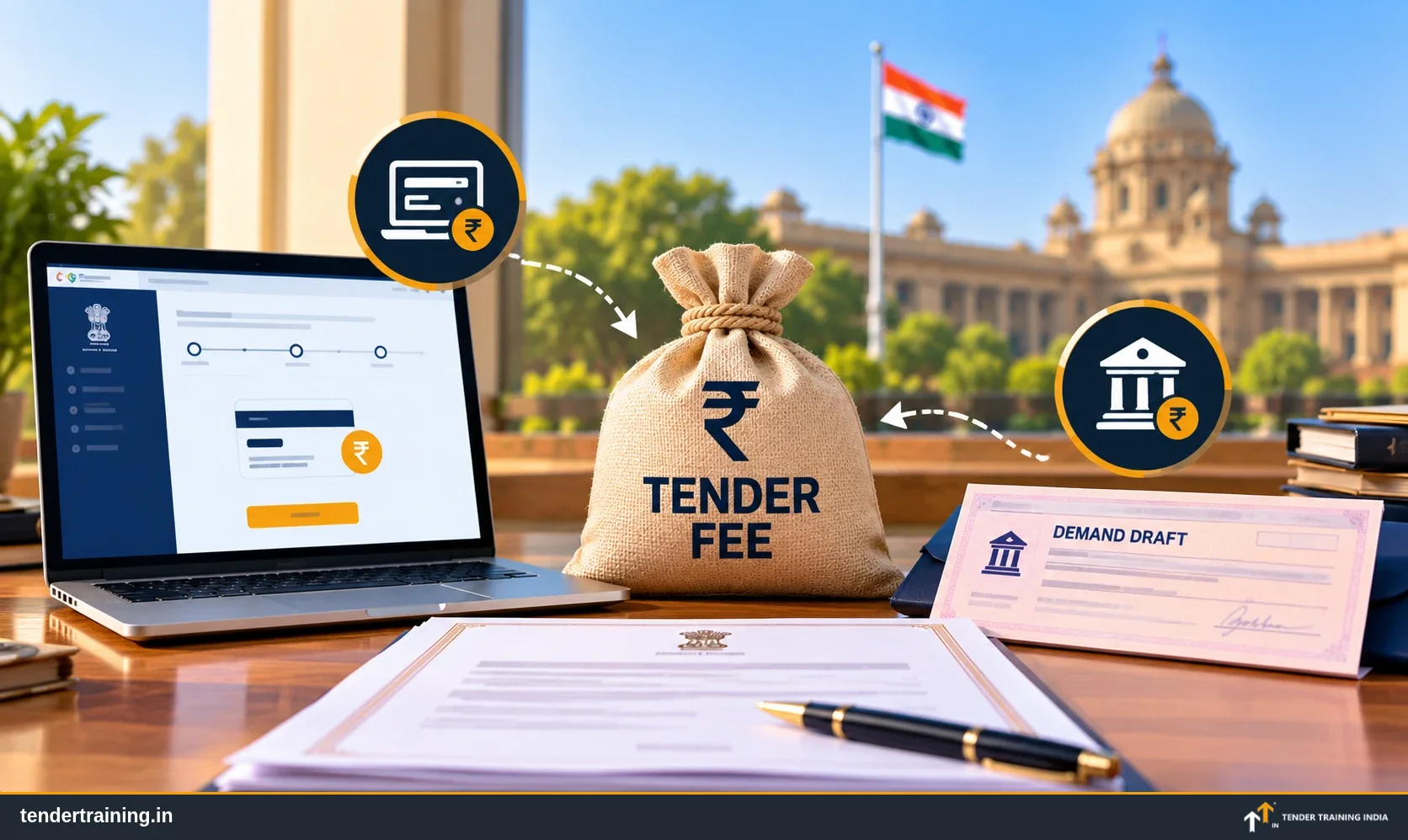
- Tender fee is the price of the tender document. It is non-refundable.
- You pay it either online on the portal, or offline by demand draft — the tender tells you which.
- Many tenders allow exemption for registered MSEs. Then you upload your certificate instead of paying.
- Wrong amount, late DD or wrong certificate = your bid can be rejected, even if your price is the lowest.
When a government department publishes a tender, it prepares a full set of papers: the rules, the specifications, the BOQ, the forms you must fill. The tender fee (also called tender document fee or cost of tender document) is the money you pay to take part with that document.
Think of it like an entry ticket. It is not a deposit — you will not get it back, whether you win or lose. Usually it is a small amount, from a few hundred rupees to a few thousand, depending on the size of the tender.
Don't confuse it with EMD (Earnest Money Deposit). EMD is a security deposit that you do get back if you don't win. Many tenders ask for both — two separate payments.
Where to find the tender fee in a tender
On the NIC eProcurement portals (the Central portal eprocure.gov.in and most state portals), every tender has a section called Tender Fee Details. It looks like this:
| Tender Fee in ₹ | 1,180 |
| Fee Payable To | Executive Engineer, Example Division |
| Fee Payable At | Pune |
| Tender Fee Exemption Allowed | Yes CHECK THIS |
Here is the same section from a real tender — a ₹68.7 lakh construction tender published on eprocure.gov.in on 8 October 2026:

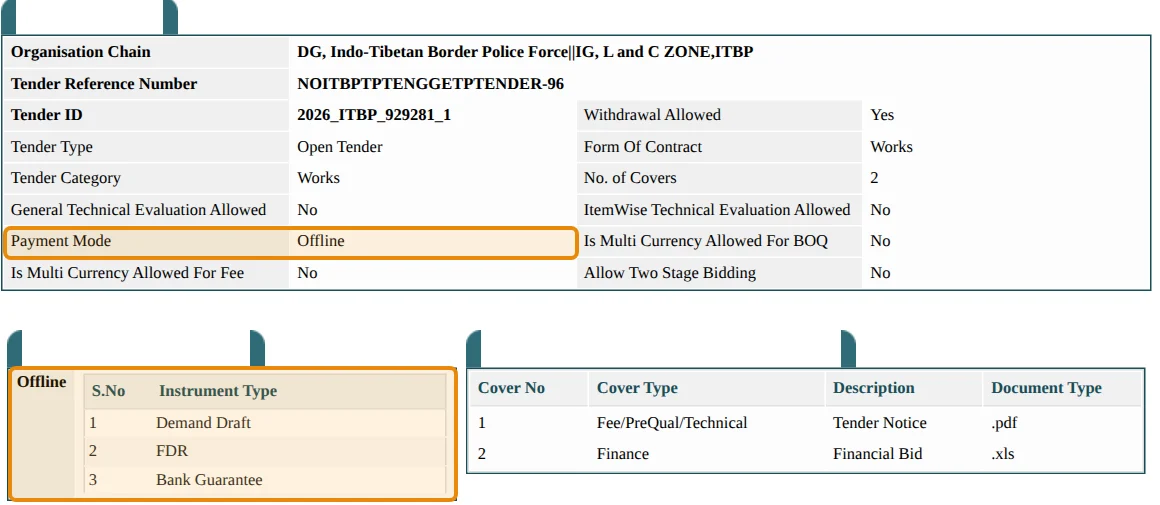
And where do you see how to pay? Two places on the same page: Payment Mode (Online or Offline) in the basic details at the top, and Payment Instruments just below it, which lists what is accepted.
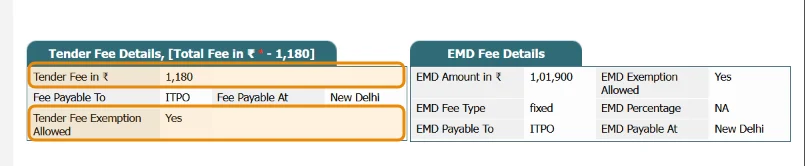
Now a tender where exemption is allowed. Here is a real one:
Online or offline: two ways to pay
1. Online payment
Most e-tenders today take the fee online. While submitting your bid, the portal takes you to a payment page where you pay by net banking, NEFT/RTGS or the payment gateway listed in the tender. The receipt is attached to your bid automatically.
2. Offline payment (demand draft)
Some tenders still ask for a Demand Draft (DD) or Banker's Cheque. Then you have to do three things:
- Get the DD from your bank, in favour of the name given in "Fee Payable To", payable at the city given in "Fee Payable At".
- Scan the DD and upload the scan with your online bid.
- Send the original DD to the office address in the tender, so that it reaches before the deadline given for physical submission.
Who is exempted from the tender fee?
Under the Government of India's Public Procurement Policy for Micro and Small Enterprises, MSEs registered on Udyam (or with NSIC) are meant to get the tender document free of cost. That is why you see the line "Tender Fee Exemption Allowed: Yes / No".
But exemption is not automatic. Three things decide it:
- The tender must allow it — "Exemption Allowed: Yes".
- You must be a micro or small enterprise (not medium) with a valid Udyam certificate.
- You must be the manufacturer (OEM) or the service provider for what the tender is buying, and your Udyam registration must show it. Traders and resellers are not eligible. If you are registered for manufacturing furniture and the tender is for security services, the exemption does not apply.
The exact conditions are always written in the tender document itself — read the "Instructions to Bidders" section once before you decide not to pay.
Five situations, five answers
Let us take one tender — a district hospital buying 120 steel beds, tender fee ₹1,180 — and see what different bidders should do.
Online fee, no exemption
Tender says fee is payable online and "Exemption Allowed: No". Sunil runs a small fabrication unit.
→ Sunil pays ₹1,180 online while submitting. Even though he is an MSE, he must pay.Offline fee by DD
Tender asks for a DD, original to reach the hospital office by 3 pm on the closing day.
→ Make the DD exactly as per "Payable To / At", upload the scan, and courier the original early. A DD that reaches late = bid rejected.Exemption allowed, MSE registered for beds
Priya's company is a small enterprise on Udyam, registered for manufacturing hospital furniture.
→ Priya does not pay. She uploads her Udyam certificate in the fee section as proof of exemption.Exemption allowed, but registered for something else
Arun has a Udyam certificate, but for printing services. He wants to supply beds by buying them from a factory.
→ The exemption is for what you make or the service you provide. Arun should pay the fee. Claiming exemption here can get the bid rejected.Medium enterprise
A company with Udyam category "Medium" wants exemption.
→ The MSE policy benefits are for micro and small enterprises only. Medium enterprises pay the fee.What about GeM?
On GeM (Government e-Marketplace), the idea of a tender fee simply does not exist. That is why a GeM bid will never show "tender fee exempted: yes / no" — there is no fee field at all. Any registered seller can view the bid and take part. EMD may still apply, with its own exemptions — see the EMD article.
A quick checklist before you submit
- Did I check "Tender Fee Exemption Allowed"?
- If I claim exemption — is my Udyam certificate valid, micro/small, and for this product or service?
- If DD — is the name and city exactly as written in the tender?
- If DD — will the original reach before the physical submission deadline?
- If online — am I paying well before the closing time?
Ask us on WhatsApp — we reply personally, usually the same day.
Ask on WhatsApp
Hiral Dron
Founder, Tender Training India · GeM Gold Certified · 15+ years in tendering, GeM and procurement advisory. Training MSMEs in government tendering since 2016.