
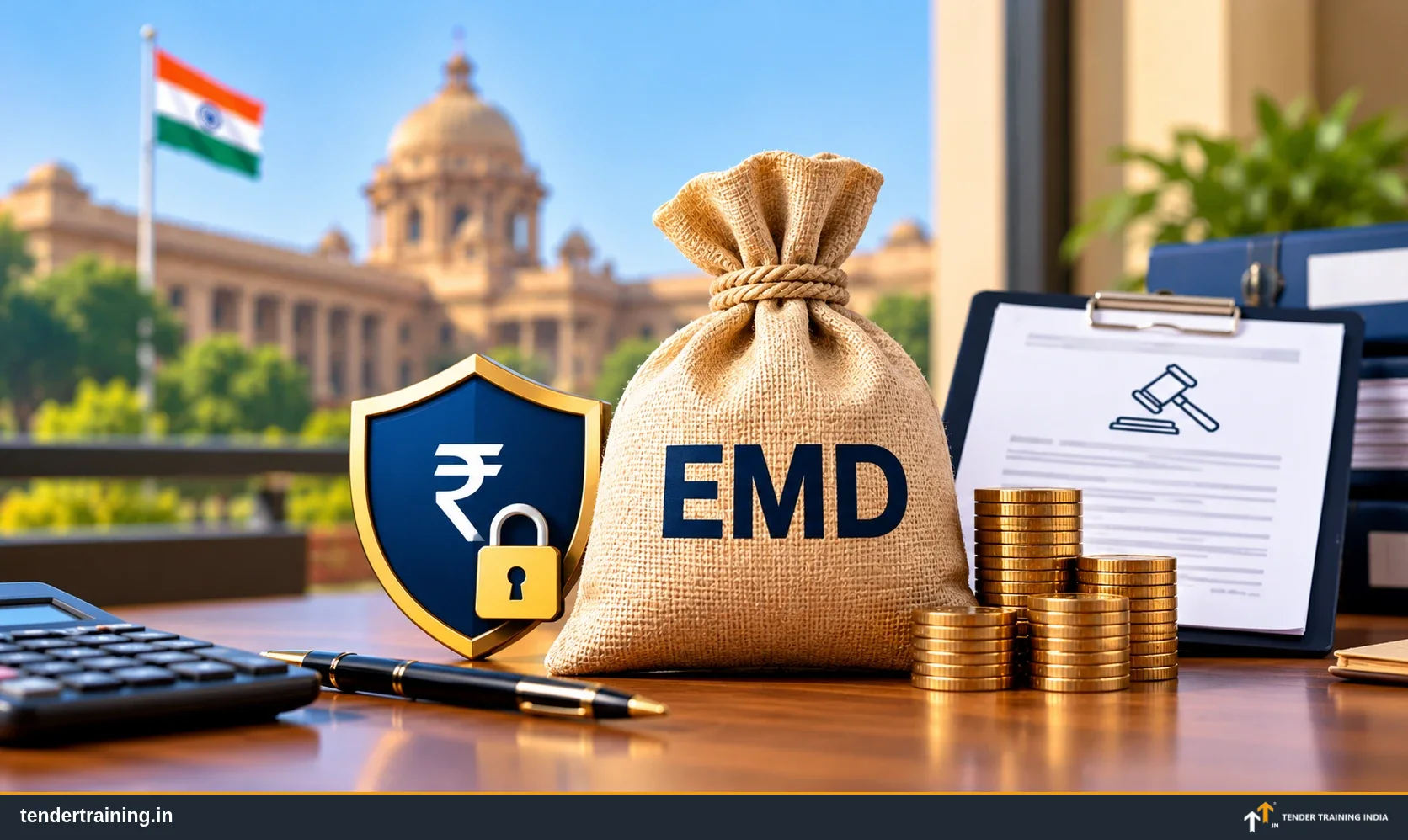
- EMD is a security deposit you give with your bid, to show you are serious.
- It is usually 2% to 5% of the estimated tender value, or a fixed amount written in the tender.
- If you lose, you get it back. If you win, it is adjusted or returned after you give performance security.
- You lose the EMD if you withdraw your bid or refuse the order after winning.
- Registered MSEs and DPIIT-recognised startups are generally exempted — if the tender allows it.
Imagine a department publishes a tender and 25 companies bid. The lowest bidder wins — and then says, "Sorry, we can't supply at this price." The department has wasted weeks and must start again. EMD exists to stop this.
EMD (Earnest Money Deposit), also called bid security, is money you deposit with your bid as a promise: "If I win, I will accept the order." If you keep that promise, you get the money back. If you break it, the department keeps it.
How much is the EMD?
The tender always states the exact EMD amount. As a rule of thumb, under the General Financial Rules (GFR) of the Government of India, EMD is normally fixed between 2% and 5% of the estimated value of the tender.
A municipal corporation wants to buy 500 office chairs. The estimated value is ₹20 lakh. The tender sets EMD at 2%.
EMD = 2% of ₹20,00,000 = ₹40,000.
Every bidder who is not exempted must deposit ₹40,000 with the bid.
Some tenders do not ask for EMD money at all. Instead, they ask you to sign a Bid Security Declaration — a written promise that if you withdraw or refuse after winning, you will be banned from that department's tenders for a period. Read the tender to see which one applies.
How do you pay EMD?
The tender lists the allowed modes. The common ones are:
| MODE | HOW IT WORKS | GOOD TO KNOW |
|---|---|---|
| Online payment | Paid on the portal through net banking / NEFT / RTGS while submitting the bid. | Fastest. Refund also comes back to the same account. |
| Demand Draft (DD) | DD in the name given in the tender. Upload the scan; send the original by the deadline. | Name and city must match the tender exactly. |
| Bank Guarantee (BG) | Your bank gives a guarantee to the department for the EMD amount. | Check the validity period the tender asks for — usually beyond the bid validity. |
| FDR / other instruments | Fixed deposit receipt pledged to the department, if the tender allows. | Not every tender accepts this. |
| EMD Amount in ₹ | 40,000 |
| EMD Exemption Allowed | Yes CHECK THIS |
| EMD Fee Type | fixed |
| EMD Percentage | NA |
| EMD Payable To | Commissioner, Example Municipal Corporation |
| EMD Payable At | Nashik |
Now a real one. This construction tender (published on eprocure.gov.in on 8 October 2026) has an estimated value of ₹68,71,071, shown on the same tender page:

EMD on GeM
When a GeM bid asks for EMD (called bid security on GeM), GeM's General Terms and Conditions recommend 1% of the estimated bid value; buyers can set it between 0.5% and 5%, and it must stay valid for 45 days beyond the bid validity. Direct and L1 purchases on GeM have no EMD at all.
On GeM, you find the EMD in the bid document (the PDF you download for every GeM bid), under "EMD Detail":
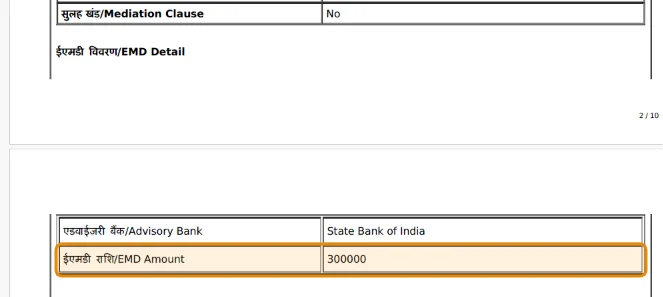
The same bid document also explains the EMD exemption and to whom the EMD must be made out:
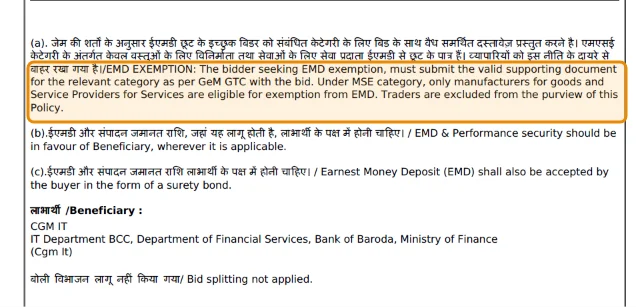
Read it slowly — it answers the three most common questions:
- Who is exempted? "Under MSE category, only manufacturers for goods and Service Providers for Services are eligible for exemption from EMD. Traders are excluded." You must upload your valid supporting document (Udyam / NSIC / DPIIT) with the bid.
- In whose name? The EMD (and later the performance security) must be in favour of the beneficiary named in the bid — here, a department of the Ministry of Finance. A DD or BG in any other name will not be accepted.
- What form? This buyer also accepts EMD as a surety bond, in addition to the usual options. Each bid can be different, so check every time.
When do you get your EMD back?
- If you don't win: the EMD is returned after the tender is decided. Government rules say it should be returned quickly — and no later than about a month after the contract is awarded.
- If you win: you will be asked to give a performance security. Once you give it, your EMD is returned (or adjusted against it).
- If the tender is cancelled: EMD is returned to everyone.
When is EMD forfeited (lost)?
You lose your EMD if you:
- withdraw or change your bid after the closing date, while the bid is still valid;
- win the tender but refuse to accept the order or sign the contract;
- win but do not submit the performance security in time.
Mahesh quotes ₹18.2 lakh for the chairs and is L1 (lowest). Two weeks later, steel prices go up, and he writes to the department saying he cannot supply. The department forfeits his ₹40,000 EMD and moves to the next step. This is why you should price carefully before you bid — once you submit, you are committed.
Who is exempted from EMD?
Government policy gives EMD exemption to:
- Micro and small enterprises (MSEs) registered on Udyam or with NSIC — but only when they are:
- the manufacturer (OEM) of the goods the tender is buying, or
- the service provider who will themselves deliver the service the tender is buying.
- Startups recognised by DPIIT.
On the tender page, look for "EMD Exemption Allowed". Here is a real tender where it is Yes:
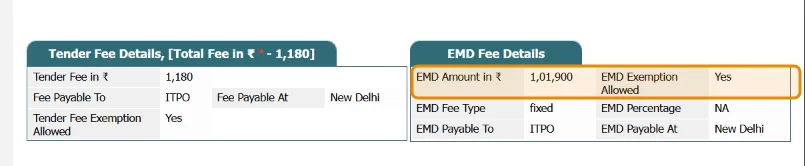
Then read the tender document to see who exactly is exempted. This is how it is written in a real tender notice:
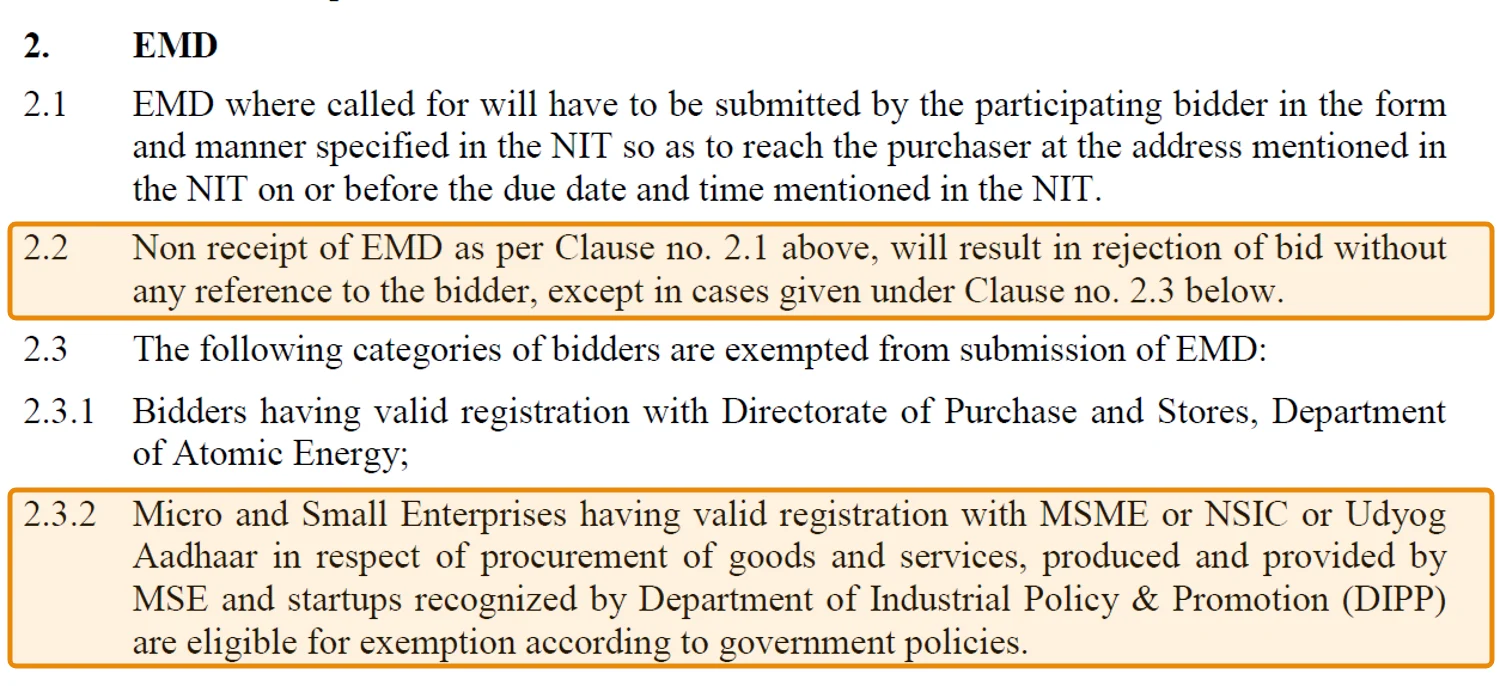
Three lessons from this one clause:
- Clause 2.2: if EMD does not reach on time, the bid is rejected "without any reference to the bidder" — nobody will call you to ask.
- Clause 2.3.1: some departments also exempt vendors who are registered with them (here, the Department of Atomic Energy's purchase directorate). Check whether you have such a registration.
- Clause 2.3.2: the MSE exemption is for what the MSE itself produces or provides. A trader supplying someone else's product does not get it. (DIPP is the old name of today's DPIIT.)
Just like the tender fee, the exemption applies only when the tender says "EMD Exemption Allowed: Yes" and your certificate covers what the tender is buying. Medium enterprises are not covered. When you claim exemption, you upload your certificate in the EMD section instead of paying.
EMD vs tender fee vs performance security
| TENDER FEE | EMD | PERFORMANCE SECURITY | |
|---|---|---|---|
| What it is | Price of the tender document | Deposit that you are serious about your bid | Guarantee that you will complete the contract properly |
| Who pays | Every bidder (unless exempted) | Every bidder (unless exempted) | Only the winning bidder |
| Refundable? | No | Yes | Yes, after the contract and warranty are over |
| Typical amount | A few hundred to a few thousand ₹ | 2–5% of estimated value | Often 3–10% of contract value |
Ask us on WhatsApp — we reply personally, usually the same day.
Ask on WhatsApp
Hiral Dron
Founder, Tender Training India · GeM Gold Certified · 15+ years in tendering, GeM and procurement advisory. Training MSMEs in government tendering since 2016.