
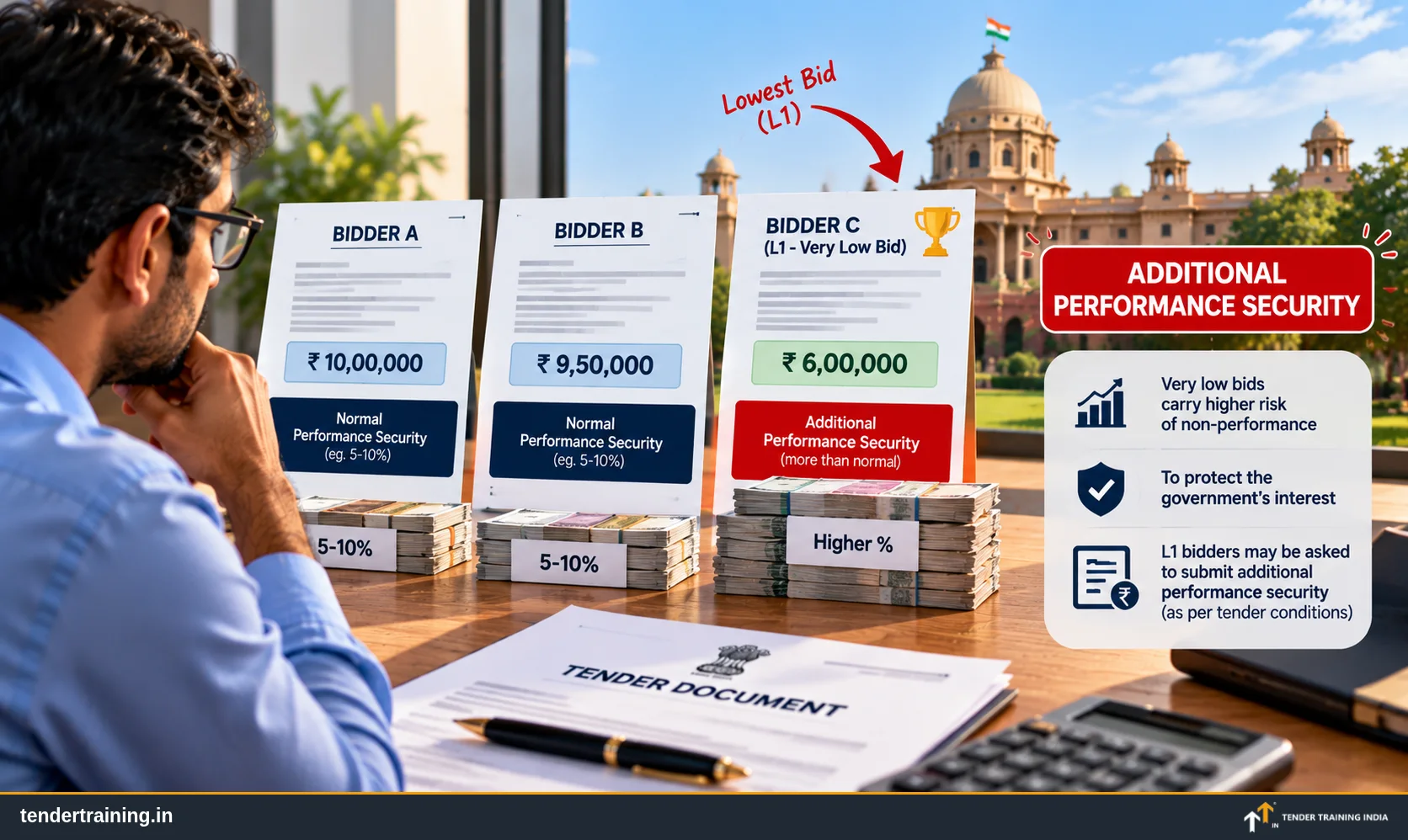
- If your bid is much lower than the department's estimate, many tenders ask the winner for an additional performance security (APS), on top of the normal performance security.
- It protects the department from bidders who quote unrealistically low and then fail to finish.
- The trigger (how far below) and the formula are written in the tender — they vary.
- Calculate it before you quote a very low price.
Every department makes an estimate before publishing a tender. When a bidder quotes 25% or 30% below that estimate, the officers worry: can this contractor really finish the work at this price, or will they stop halfway? The additional performance security — also called additional performance guarantee or additional security deposit — is how they protect themselves.
Why does it exist?
A very low bid is not illegal. But experience shows that some bidders quote too low to win, then delay the work, cut quality, or abandon it — and the department has to re-tender, losing months. Asking for extra security from such bidders makes them think twice and gives the department a cushion if things go wrong.
How is it calculated?
The tender gives the rule. In works tenders, a common type of clause says: if the accepted bid is more than a certain percentage below the estimated cost, the bidder shall deposit additional performance security equal to the difference between that limit and the bid amount.
Suppose a tender says: "If the bid amount is more than 10% below the estimated cost, the successful bidder shall submit additional performance security equal to the difference between 90% of the estimated cost and the bid amount."
Estimated cost: ₹1,00,00,000. 90% of this = ₹90,00,000.
- Bidder A quotes ₹93,00,000 (7% below) → no APS. Only normal performance security.
- Bidder B quotes ₹78,00,000 (22% below) → APS = ₹90,00,000 − ₹78,00,000 = ₹12,00,000, plus the normal performance security.
If the normal performance security is 5% of ₹78 lakh = ₹3.9 lakh, Bidder B must arrange ₹15.9 lakh of guarantees in all — about 20% of the contract value.
Other tenders use a different trigger (for example 15% or 20% below) or a different formula. Some GeM bids also add conditions for abnormally low prices in the ATC. Read the exact clause in your tender — usually in the instructions to bidders or special conditions.
When do you get it back?
This depends on the tender. Commonly it is returned along with the performance security after successful completion — sometimes earlier, once the work reaches a stage. Some tenders allow it to be adjusted against bills. Check the clause so you know how long your money or bank limit stays blocked.
Before you quote low — a quick check
- Find the APS clause and note the trigger percentage.
- Work out how far below the estimate your price is (for percentage-rate BOQs, it is simply your quoted percentage).
- Calculate the APS amount, and add the normal performance security.
- Check with your bank whether your limit can cover both, within the deadline.
- Ask yourself honestly: at this price, can I finish the work with the quality required?
Ask us on WhatsApp — we reply personally, usually the same day.
Ask on WhatsApp
Hiral Dron
Founder, Tender Training India · GeM Gold Certified · 15+ years in tendering, GeM and procurement advisory. Training MSMEs in government tendering since 2016.