
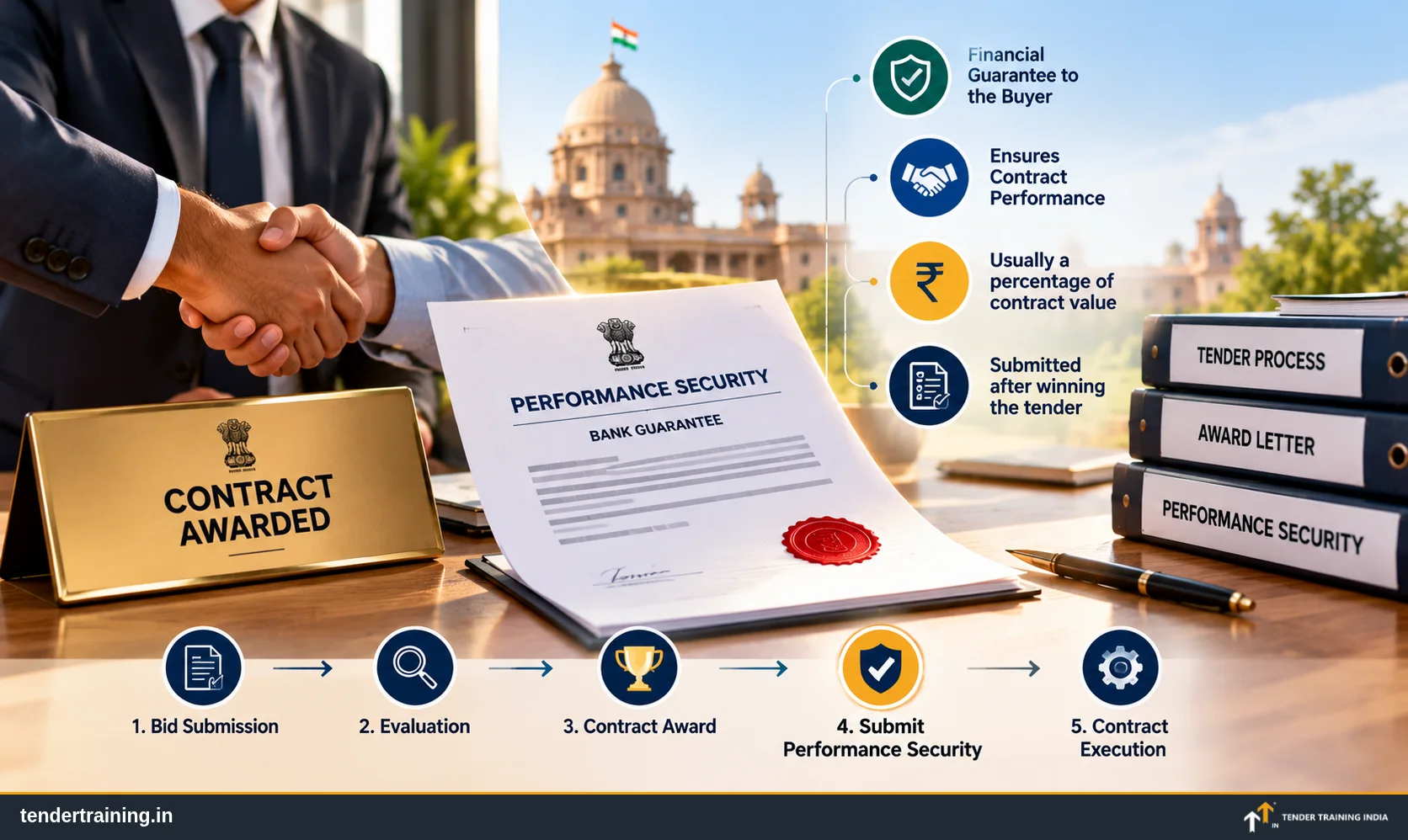
- Performance security is a guarantee the winning bidder gives, promising to complete the contract properly.
- It is usually a percentage of the contract value — under central government rules, typically 5% to 10%. The tender states the exact figure.
- It is given as a bank guarantee, FDR, DD, online payment or insurance surety bond — whatever the tender allows.
- You get it back after the contract and the warranty / defect liability period are over.
Your EMD promised that you would accept the order if you won. The performance security is the next promise: that you will actually deliver — on time, to the specifications, and fix defects if they appear. It is also called performance bank guarantee (PBG), performance guarantee or security deposit.
How much is it?
The tender or the contract states it. Under the Government of India's General Financial Rules, performance security for goods and works is normally 5% to 10% of the contract value. States and PSUs have their own rules, so always read the figure in your tender.
Anil wins a ₹40 lakh tender for supplying lab equipment. The tender asks for performance security of 5%.
Performance security = 5% × ₹40,00,000 = ₹2,00,000.
His EMD of ₹80,000 is returned once he submits the performance security.
In what form?
- Bank guarantee (BG) — the most common. Your bank guarantees the amount to the department. The bank usually blocks some margin money or uses your credit limit.
- FDR — a fixed deposit pledged in the department's favour.
- DD / online payment — simple, but your cash is locked until refund.
- Insurance surety bond — accepted in many government contracts now, and easier on bank limits.
Use only a form the tender allows, in favour of the exact name it gives, and from the kind of bank it accepts.
When do you submit it, and for how long?
The work order or contract gives a deadline — often within two to three weeks of the award (central rules mention 21 days). The guarantee must stay valid until after all your obligations end — including the warranty or defect liability period — usually with a margin of about 60 days beyond that.
When do you get it back — and when can you lose it?
You get it back after the contract is completed and the warranty / defect liability period is over, once the department confirms there are no dues or claims.
The department can encash (forfeit) it if you:
- do not complete the supply or work;
- supply material that fails specifications and do not replace it;
- do not fix defects during the defect liability period;
- breach the contract in other serious ways stated in it.
What about GeM?
On GeM, performance security (ePBG) applies to contracts placed through a bid or reverse auction — not to direct or L1 purchases. Under GeM's General Terms and Conditions (v1.29, March 2026) it is usually 3% to 5% of the contract value, must be submitted within 15 days of the award, and must stay valid for 2 months beyond all contractual obligations, including warranty. Until the buyer receives and verifies it, payment for the order is not due. The bid document states the exact percentage.
Tender fee, EMD and performance security — side by side
| TENDER FEE | EMD | PERFORMANCE SECURITY | |
|---|---|---|---|
| When | With the bid | With the bid | After winning |
| Who | All bidders (unless exempt) | All bidders (unless exempt) | Only the winner |
| Refund | No | Yes, after award / on PS | Yes, after contract + warranty |
| Typical size | Small fixed amount | 2–5% of estimate | 5–10% of contract value |
Note: MSE exemptions apply to the tender fee and EMD — not to performance security. Even an exempted MSE winner must give it.
Ask us on WhatsApp — we reply personally, usually the same day.
Ask on WhatsApp
Hiral Dron
Founder, Tender Training India · GeM Gold Certified · 15+ years in tendering, GeM and procurement advisory. Training MSMEs in government tendering since 2016.