

- NIT = Notice Inviting Tender. It is the short public announcement of a tender.
- It tells you what is being bought, how much it is worth, who can bid, the fees and EMD, and the last dates.
- The full rules are in the tender document. The NIT is the summary.
- Use the NIT to decide quickly: bid, or skip?
Every day, thousands of tenders are published across India. You cannot read every tender document fully — some run into hundreds of pages. That is where the NIT helps. It is like the trailer of a film: in one or two pages, it tells you what the tender is about, so you can decide whether to watch the whole thing.
What is an NIT?
NIT (Notice Inviting Tender) is the official notice a department publishes to announce a tender and invite bids. Some departments call it Tender Notice, Invitation for Bids (IFB) or Notice Inviting e-Tender (NIeT). All mean the same thing.
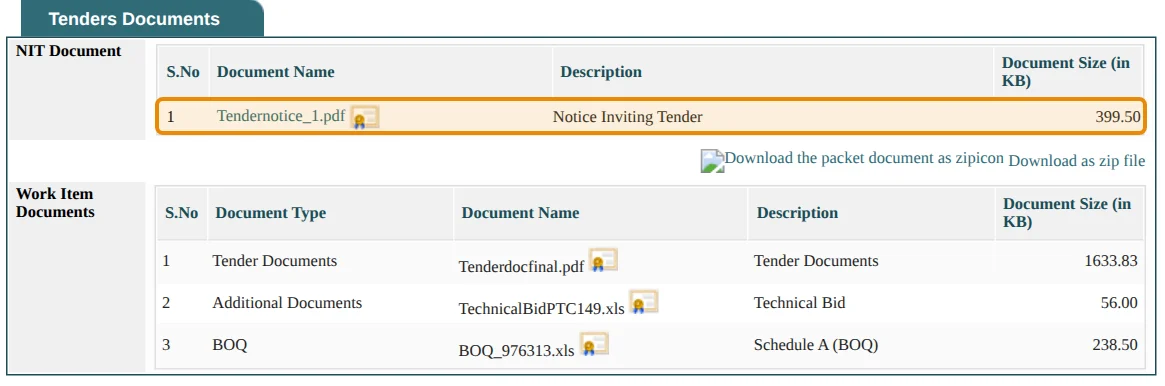
It is usually the first PDF attached to the tender — on eProcurement portals you will see it listed as "NIT Document":
What does an NIT contain?
Every department has its own format, but almost every NIT covers these points:
| POINT | WHAT TO LOOK FOR |
|---|---|
| Name of work / item | Exactly what is being bought or built — and where. |
| Estimated cost / tender value | Tells you the size of the job, and whether it fits your capacity. |
| EMD and tender fee | How much, in what form, and whether exemption is allowed. |
| Period of work / delivery | How many days you get to complete the work or supply. |
| Eligibility | Turnover, experience, registrations needed — often in short form. |
| Key dates | Document download, pre-bid meeting, last date of submission, bid opening. |
| Bid validity | How many days your price must stay valid after opening. |
| Tender inviting authority | Which officer and office — useful for queries and for DDs. |
A real NIT, read in 5 minutes
Let us read the key details of a real tender published on 8 October 2026 — road work at BARC, Tarapur (Maharashtra). On the eProcurement portal, the main NIT details appear on the tender page itself:
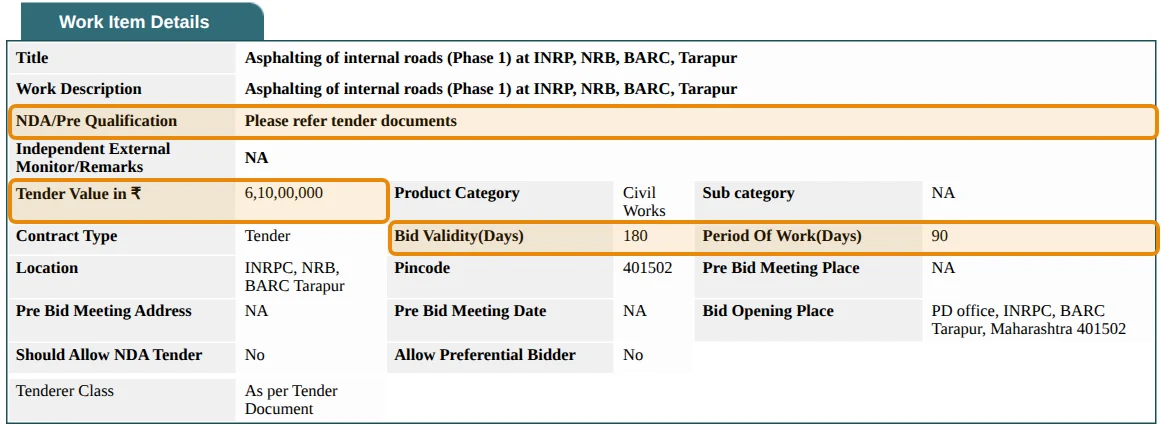

From these two boxes (and the EMD box we saw in the EMD article), here is what a quick reader learns:
- Work: asphalting of internal roads at BARC Tarapur — civil works.
- Size: ₹6.10 crore. Not a small job — turnover and experience conditions will be serious.
- Time: 90 days to finish. You need machinery and a team ready to move.
- EMD: ₹12,20,000 (2% of value), no exemption — you need this money or a bank guarantee ready.
- Last date: 26 October 2026, 5 pm. Bid opening 29 October.
- Bid validity: 180 days — your price must hold for six months.
- Eligibility: "Please refer tender documents" — so the next step is to read the pre-qualification criteria in the full document.
A road contractor in Palghar with a few crores of turnover would say: "Worth reading fully." A small furniture maker would say: "Not for me," and move on — in under five minutes. That is the whole purpose of the NIT.
Your 5-minute bid / no-bid checklist
- Is this my product or service? Read the name of work and the item description.
- Can I handle the size? Compare the tender value with your turnover and past work.
- Can I deliver in time? Check the period of work / delivery period.
- Do I have the money ready? EMD amount, tender fee, and later the performance security.
- Is there enough time to prepare? Check the bid submission end date — and keep a margin of at least two days.
- Any quick eliminators? Location restrictions, special registrations, Class-I local supplier conditions.
If all six look fine, download the full tender document and start reading properly.
What about GeM?
On GeM, there is no separate "NIT" PDF. The first pages of the GeM bid document do the same job: they list the item, quantity, bid end date, EMD, eligibility (turnover, experience, MSE/startup relaxations) and the documents required. Read those first pages exactly the way you would read an NIT.
Ask us on WhatsApp — we reply personally, usually the same day.
Ask on WhatsApp
Hiral Dron
Founder, Tender Training India · GeM Gold Certified · 15+ years in tendering, GeM and procurement advisory. Training MSMEs in government tendering since 2016.